Showing posts with label surgery. Show all posts

Monday, March 4, 2013

Ask the Vet- Tripods by Kristel Weaver, DVM, MPVM


Learning that your dog or cat needs an amputation brings up a lot of questions.  I’ll discuss common concerns about living with a pet that has undergone an amputation and share my own experiences on life with a tripod, my favorite term for a three-legged dog or cat.

Why would a dog or cat have a leg amputated?
The most common reasons for a dog or cat to need an amputation are trauma, cancer or a congenital defect.   Trauma injuries can result from being hit by a car, falling out a window or getting attacked by another animal.  A dog attacked my cat and caused severe trauma to his back left leg.  After trying unsuccessfully to get his injuries to heal, I amputated his leg and he has been happy ever since.  When a dog is diagnosed with a bone tumor or a cat has a vaccine-associated sarcoma on one of their legs, we recommend an amputation to remove the cancer. Congenital defects or neonatal injuries can lead to malformed limbs that are painful and can’t be used normally.  If a leg is constantly painful and cannot be fixed, amputation may be the best option.

Are dogs and cats embarrassed when they lose a leg?
Not at all!  Tripods seem to have no comprehension that they are different from their friends and don’t show any signs of being ashamed or embarrassed.  They are as happy, silly and playful as they were previously.  There is no emotional aspect for them to lose a limb.  As an owner of a tripod, you will probably get extra attention and questions about your dog or cat’s condition.

Can a tripod still live a normal life?
Yes!  Dogs and cats with only three limbs can live completely normal lives.  They can still exercise and play, go for walks, cuddle, nap and eat regular food.  They can still bark at the mailman or hide from the vacuum cleaner.  Pets with a back leg amputation will not be able to jump as high as a four-legged friend.  The exception is obese, geriatric or severely arthritic dogs and cats.  These animals will have a hard time walking around after an amputation may not be good candidates for the surgery.

What can I do to make life easier for my tripod?
Keep your tripod thin!  Extra weight puts more strain on the remaining legs. 
  • Raise the food and water bowls for dogs with front leg amputations, this helps so they don’t have to bend down on their one front leg.
  • Arrange the house so the floors have traction.  Use rugs, runners, yoga mats or whatever helps prevent your dog from slipping as they zip around. Hardwood or tile surfaces can lead to spills.
  • If your dog or cat needs an amputation I recommend you talk to other pet owners with tripods and visit their pets to see how happy they are.  My three-legged cat has no idea he is missing anything and still sprints around the house, jumps on the bed, runs upstairs and rules over the dogs.
Check out these cool videos of Schwartz the three-legged cat and Nuchal the three-legged dog running and playing!


Dr. Kristel Weaver is a graduate of the Veterinary School at the University of California, Davis where she received both a DVM and a Master’s of Preventative Veterinary Medicine (MPVM).  She has been at Bishop Ranch Veterinary Center & Urgent Care in San Ramon since 2007.  She currently lives in Oakland with her husband and their daughter, Hayley. If you have questions you would like Dr. Weaver to answer for future articles, please email info@webvets.com


Monday, July 30, 2012

Lives Saved: Sammy by Erin Selby

Name: Sammy Sugimura 
Age: 7 1/2 years 
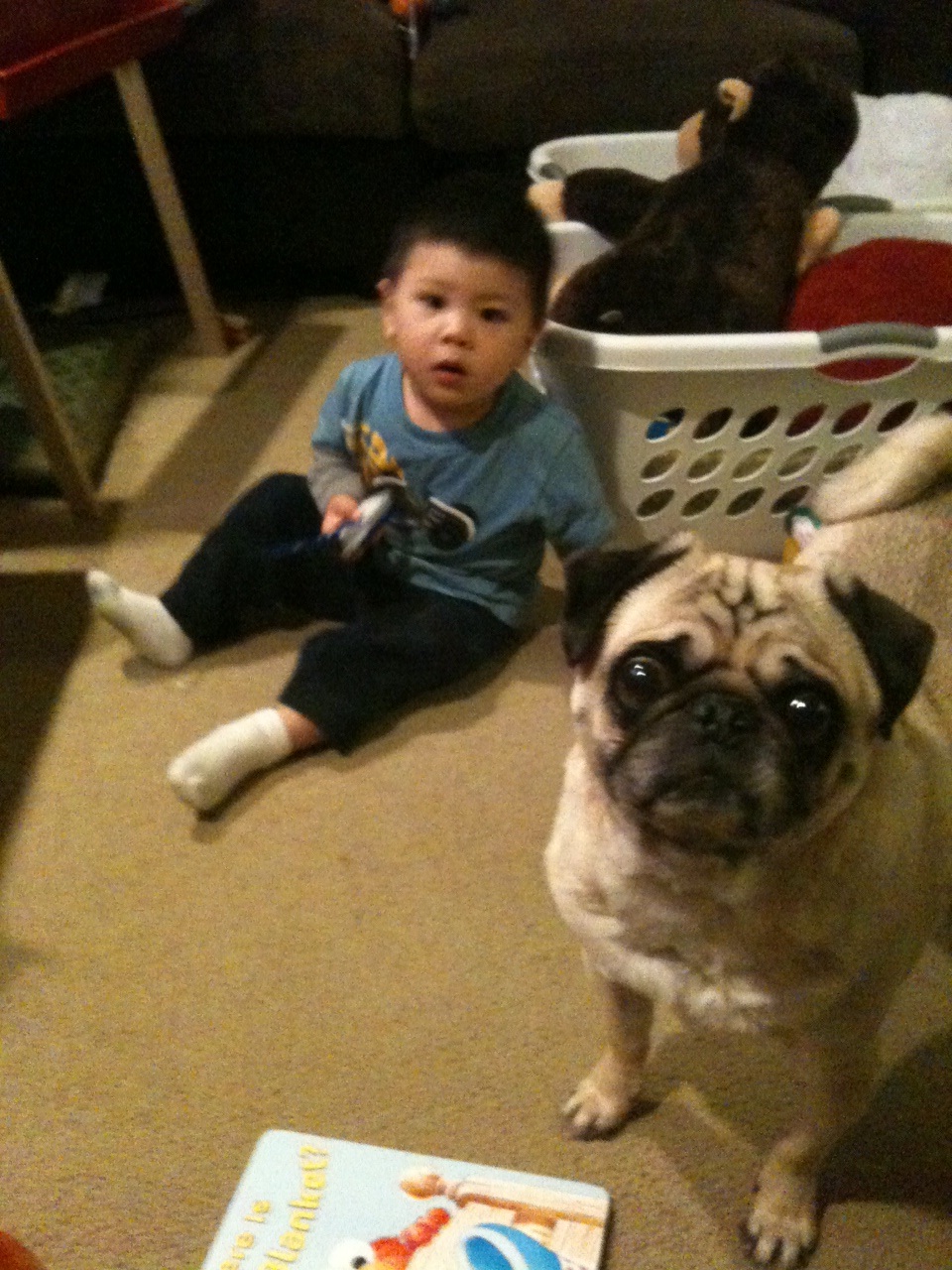
Breed: Pug
Diagnosis: Intestinal Obstruction

Memorial Day weekend is usually a time of relaxation, good food, and fun, family outings. But the Sugimura family was having a very different kind of holiday experience. Sammy, their beloved 7-year old Pug, had not eaten for two days. In addition to the lack of appetite he was vomiting bile.  Extremely worried, Sammy’s family took him to a veterinary clinic they had used in the past. After numerous tests they were unable to find anything conclusive. The Sugimuras took Sammy home fully hydrated, hoping he would get better. Instead, Sammy continued to get worse and began vomiting bile several times a day. After doing some research online, Sammy’s dad Jeff decided to call Bishop Ranch Veterinary Center & Urgent Care. “Renee took my call and her genuine concern for Sammy shone through on the phone.  He had started breathing heavily, like a canine version of Darth Vader, and he was getting cold . . .” said Jeff.  Renee had Jeff bring Sammy down immediately for Urgent Care.

Upon presentation Sammy was very weak and had difficulty getting up.  When Dr. Larry Gilman examined him he found Sammy to be very cold with a painful abdomen. Even his breath was cold! It was determined that Sammy was in shock and probably had an intestinal obstruction. Dr. Gilman and his team of technicians immediately sprang into action by using special medical equipment to help heat Sammy up as well as placing him on an IV in order to administer large doses of fluids to combat the shock. Dr. Gilman’s next step was to talk to the Sugimuras about developing a plan of action. Additional diagnostics needed to be performed including blood work in our in-house laboratory, digital x-rays, and possibly an ultrasound. While these tests were being performed Sammy was started on critical care support consisting of fluids, hetastarch, antibiotics, and pain medication in order to combat his severe state of shock and dehydration. Just as Dr. Gilman suspected, his x-rays showed an intestinal blockage in his small intestines which was confirmed with an ultrasound. To complicate matters, Sammy’s blood work revealed that he was in acute kidney failure due to his shock and the length and severity of his illness. 


Dr. Gilman knew that once Sammy’s shock was managed surgery would be necessary in order to remove the blockage and that some of his intestines would have to be removed. Because of Sammy’s critical condition, his chances of surviving surgery were about 50/50. Dr. Gilman delivered the sober news to the anxious Sugimuras. According to Jeff, “I was very impressed with Dr. Gilman, who told us that he would require surgery and that there was a good chance we could lose Sammy due to his already compromised condition.  You never want to hear news like this, but we appreciated his candor and how straight-forward he was.  You can't sugar coat things like this and many try and do this in the same situation.  For my wife and me, it wasn't a difficult decision aside from a costly one.  Sammy is our ‘first child’ and we weren't going to just give up on him.  So we authorized Dr. Gilman to perform the surgery and hoped for the best.”


The next few hours were spent treating Sammy’s shock, dehydration, pain, and kidney failure. As soon as his temperature was back up and his pain was under control it was time to go into surgery. Jeff and his wife came in to see Sammy prior to surgery. This was a very emotional time for them since they knew Sammy might not make it. Dr. Gilman had prepared them and let them know that even if he made it through the surgery, there was a still a risk that Sammy might succumb to his injuries during recovery.  Jeff shared, “We took our 4 1/2 year old son, CJ over to see Sammy before they put him under.  We wanted to say our goodbye's just in case it was the last time we saw him.  Unfortunately, our son didn't really ‘get it’ and was more interested in the other dogs at the hospital and why some of them had cones on their heads.”


The surgery was performed and a 24-inch section of Sammy’s intestine had to be removed since the foreign body had caused severe compromise of the intestinal tissue and its blood supply. Sammy was closely observed throughout the surgery using our specialized equipment for monitoring vital signs such as blood pressure, heart rate and rhythm, and respiratory rate. The foreign body that was causing the obstruction was removed and revealed to be a mass of human hair. It turns out that Sammy had a bad habit of licking the carpet and over time had accumulated a mass of hair in his intestines. This was difficult news for Jeff’s wife, as she had the long hair in the family. To make matters worse, she had to leave town the day after surgery on a business trip for two weeks. Needless to say it was devastating for her to have to leave Sammy’s side not knowing if he was going to survive or not.

Sammy’s surgery was a success but the next 48 hours were critical to his recovery. He needed to stay at Bishop Ranch Veterinary Center in order to receive post-operative critical care so we could monitor his kidneys and the healing of his intestines. 24-hour care from highly trained veterinary technicians was absolutely essential during this sensitive window of time.  Sammy was in Patient Care for three days. He was making a very good recovery – his vitals looked good, he was responsive to treatment, and was getting happier every day. The only problem was he wouldn’t eat. Dr. Gilman discussed the situation with Jeff and they agreed to see how Sammy would do at home on medication and a bland diet. Since all of his vitals looked positive and proper nutrition is important for the intestines to heal, home treatment was the next logical step in Sammy’s recovery. Their decision was the right one. Once he was back in the familiar comfort of his own home, Sammy began to regain his appetite. 

Dr. Gilman was in contact with Jeff daily for the next few days in order to make sure Sammy was still on the right track. When the tough little pug returned two weeks later for his suture removal he was completely back to normal and had made a full recovery! Sammy is back to his favorite activity of running around outside chasing the birds and squirrels, his appetite is as healthy as ever, and loves playing with his best human friends – the Sugimura’s two children CJ and Jace!
Jeff had the following to say after Sammy’s harrowing ordeal, “If you looked at him today, you'd never know he went through all that he did.  And that's exactly how I like it.  We're so fortunate to be able to have more time with him and that he was such a great fighter.  It also was another reminder about how you can't take each day with others for granted (or take others for granted) because you'll never know when you might face losing those that you love.  I have to say that everyone that I came into contact with was courteous, polite and you could tell that they really cared about the animals as though they were family (Sammy HAD become family after all he went through as most of the staff recognized him by the time we left!).  The professionalism and kindness exhibited throughout the clinic is stellar. . . Dr. Gilman was a breath of fresh air as a doctor.  He is a straight shooter, gets right to the point and doesn't sugar coat anything (which I really appreciate).  Throughout the process, Renee would sit down with me and go over the bill and specific charges so that we always knew where we stood.  Was it cheap? No.  But what kind of quality care is?  They were very straight-forward with the financial side of it and I very much appreciated it.  Dr. Gilman saved our Sammy's life and I am truly thankful for everything that he and the rest of the staff did for our dog.  Our kids are thrilled to have Sammy back at home safe (OK, our 2 year old has no idea what happened and what Sammy had been through, but they're still best friends). As far as I am concerned, Dr. Gilman is Sammy's new vet and the Bishop Ranch Veterinary Center has gained a new client in our family.”

The staff and doctors at Bishop Ranch Veterinary Center & Urgent Care work together as a team in order to provide the best possible care for your pet and for you! Life does not slow down for emergencies but we are here to help you and your pet when you need it the most.

Monday, June 4, 2012

Ask the Vet - Gastric Dilation and Volvulus (GDV) AKA Canine Bloat by Kristel Weaver, DVM, MPVM


I just adopted a Great Dane puppy and my breeder mentioned some precautions to prevent bloat.  What is bloat?

Bloat, or gastric dilatation and volvulus (GDV), is when the stomach fills with gas and flips over. This twists blood vessels, blocks blood flow and traps gas. The gas and pressure builds up, forcing the stomach to expand. Within a few hours or less the stomach is extremely stretched and hard, and the stomach tissue begins to die. Circulation is cut off, causing the dog to go into shock. Without emergency treatment GDV is fatal. Even with aggressive therapy, some dogs do not survive.

 What does a dog with GDV look like?

Dogs with GDV are very uncomfortable – as you can just imagine! They act restless and try to vomit but nothing comes up. As their stomachs fill with gas, their abdomen appears bloated just behind the ribs. If you think your dog has these symptoms, regardless of the breed, take him or her to your veterinarian immediately.

What causes GDV and what breeds are at risk?

No one knows exactly what cause GDV. Past cases show the biggest risk factor is a big, deep chest. The risk increases as a dog gets older and the ligaments around the stomach stretch out. The breed most at risk is the Great Dane; about 2 out of every 5 have GDV. Some other breeds at risk are St. Bernards, Setters, Weimaraners, Standard Poodles, German Shepherds, and the list goes on.

What can be done to prevent GDV?

A surgery called a gastropexy can prevent GDV. In it, the stomach is sewn to inside of the body wall, preventing it from flipping over. This surgery can be done safely with either a laparoscope or traditional surgical method. It's typically done at the same time a deep-chested or large breed dog is spayed or neutered. Aside from a gastropexy, there is no guaranteed method to prevent GDV. Another factor to consider is that emergency GDV treatment and surgery can range from $3000 to $7000, depending on the hospital, while a preventive laparoscopic gastropexy is about a third of that cost.
If you're concerned about bloat, talk to your veterinarian about a gastropexy. In my opinion, it is absolutely worth the peace of mind!  

Dr. Kristel Weaver is a graduate of the Veterinary School at the University of California, Davis where she received both a DVM and a Master’s of Preventative Veterinary Medicine (MPVM).  She has been at Bishop Ranch Veterinary Center & Urgent Care in San Ramon since 2007.  She currently lives in Oakland with her husband and their daughter, Hayley. If you have questions you would like Dr. Weaver to answer for future articles, please email info@webvets.com

Friday, February 24, 2012

A Letter from Dashiell Hammett the Beagle by Erin Selby


It is a dreaded moment for all pet owners - the moment when the doctor informs you that your pet has to wear an e-collar (aka the cone of shame).  Our pets aren't aware that it is for their own protection, and it is doubtful they would appreciate it even if they did understand. It is tough for us to witness: those soulful eyes pleading with you, begging you to remove the torture device. The whimpering and whining and the constant attempts at breaking free. Not to mention bumping into everything from the couch to the wall to your legs. There is no doubt about it, it is a challenge to cope with - for both the pet and the owner! Despite how hard it is for both parties, it is important to be vigilant and keep the cone on as long as it is necessary. The amount of time needed varies from pet to pet and depends on what the collar is being used for; which can be anything from licking and self-chewing to a healing incision site. A cone that comes off too soon can lead to infection and longer healing times.

Dashiell and his family experienced this frustration first hand after he was neutered last week and was sent home with the wretched cone of shame. Dr. DeLano, Dash's veterinarian, received a very special letter from the Beagle detailing his trauma:


Dear Dr. DeLano,

Just wanted you to know I did not like the cone.

My parents left me home in my crate with that cone thing on while they went out for a couple hours last night. 
 
To entertain me, they put on a movie, The Treasure of the Sierra Madre.  When the bandit said, “Badges, we ain’t got no badges.  We don’t need no badges. I don’t have to show you any stinkin’ badges,” I got an idea! 

Cone, I don’t need no cone.  I don’t like no cone.  I ain’t gonna wear no stinking cone!  And as you can see by the cone and parts, I will no longer wear that cone thing.

Your friend and patient,

Dashiell Hammett Beagle
 
The aftermath:


All better and happy to be free:


I would like to give a special thank you to Dashiell's family for sharing!

Tuesday, January 17, 2012

Scratching & Declawing: Options & Alternatives


Some cats use their claws destructively indoors by clawing the furniture or carpet. For those cats, there are solutions to help curtail this habit.

Scratching is a completely natural and normal behavior for your cat. It helps sharpen their claws, acts as a scent and visual marker, and aids in stretching.  Scratching is important to cats and feels good, however it can be destructive to a household and hard to control. By providing your cat with alternatives to your furniture, you can help discourage destructive scratching.

The first step is to provide some acceptable scratching material for your cat. Cat trees are ideal because not only can your cat scratch it, but it also gives them something to climb and perch on. Cats love high places from which to view their surroundings.  Make sure the cat tree is stable enough for your cat to run, jump, and climb on and has suitable material for their claws to dig into.

There are also horizontal posts available that can be placed on the ground for scratching, as well as vertical posts that hang from the door. These come in many different materials such as carpet, sisal rope, and corrugated cardboard. You may need to experiment to see which kind your cat likes best but a variety of options is ideal to prevent boredom. 

If your cat has already started scratching furniture and carpet in your house, you may want to choose a cat tree or scratching post that is covered in a different material to avoid confusion. Sisal rope is usually very popular with cats. You will want to have scratching options placed throughout your home and especially near or in front of spots your cat has already decided to claw at.  You can slowly move the tree or post a little bit each day to where you would eventually like it to be located.

To help entice your cat to use their new post, try rubbing some catnip on it. When you see them scratching a post or playing on their tree, make sure to reward the good behavior with treats. This will help encourage appropriate scratching. It is usually not helpful to force a cat’s paws onto a tree or scratching post. 

There are a variety of ways to help make areas you do not want your cat to scratch less appealing.  While you are training your cat to use their new scratching materials you can place foil, plastic sheeting, or double sided tape on or around furniture.  Cats dislike sticky surfaces so double sided tape is an excellent deterrent. If you do not want to place double sided tape directly on your furniture, you can place carpet runners with the pointy side facing up in front of anything you want to mark as off limits. Use a water bottle to squirt your cat if you catch them scratching somewhere off limits. While these measures do not look attractive, it is hopefully temporary as your cat establishes appropriate clawing behavior. Patience and persistence are required in order to train your cat to create new scratching patterns.

There are other options besides scratching posts and cat trees. First, there is a non-surgical alternative using Soft Paws. These are hollow “false nails” that fit like a cup over the claw and are glued in place. They stay on the nail for 4 to 6 weeks, and fall off as the nail grows. Replacement for most cat owners is a simple procedure. You can purchase a set of Soft Paws over the counter. We can glue on the first set of Soft Paws while you watch so you can see how we do it. After that we can continue to apply future sets of Soft Paws, or you can do it yourself at home. 

Another option is a surgical procedure referred to simply as declawing. This is the traditional method that has been performed to prevent cats from using claws. Declawing is a drastic and permanent solution when all other options have been exhausted. During the procedure the surgeon amputates the claw and last bone in each toe, from which the nail actually grows. It is essential that this bone be removed with the claw. This ensures that all the nail-producing cells are removed, thereby preventing re-growth of the nail. Either a small dissolvable stitch or tissue adhesive is used to close the skin together at the end of each toe when the procedure is completed. 

This procedure is performed under general anesthesia and multiple forms of pain medications (local, injectable, oral, and patches) are often used to reduce post operative pain. The apparent degree of pain experienced by a cat varies from case to case. Your cat will stay at the hospital 1 to 2 nights with its feet bandaged and pain level monitored.  

Once your cat goes it home it will likely need to continue on some form of pain medication as it is not uncommon for there to be discomfort. Your cat may experience pain for several days or even a week or more post operatively. During this time they will need to be confined in order to prevent trauma to the feet.
Cats rely on their claws for defense and should remain indoors after the surgery. There are reports that some cats show an increase incidence of biting following the surgery (presumably due to lack of claws for defense) but this is not a consistent finding. Any of our veterinarians will be happy to answer questions you may have about this procedure.