Showing posts with label Lives Saved. Show all posts

Friday, August 3, 2012

Lives Saved: Lightening Hendricks

Name: Lightening Hendricks
Breed: Desert Tortoise
Age: Over 60 years old
Diagnosis: Trauma to legs and abdomen 

Having a pet in the family for over 50 years seems nearly impossible, but the Hendricks estimate that Lightening, their not-so-speedy California Desert Tortoise, is probably over 60 years old. She has lived in their yard for, literally, decades. In September of 2009 they found her not moving, with large gaping wounds in front of both of her rear legs. The wounds were deep, all the way through the skin, perhaps entering the belly, and filled with debris and maggots.The Hendricks brought her to Dr. Ikezawa at Bishop Ranch Veterinary Center & Urgent Care.

Lightening was understandably painful and ill, not moving much and losing interest in eating. While it is not known for sure what caused Lightening's wound there is a high probability that they were caused by a raccoon. She was sedated and her wounds were cleaned aggressively. Tortoises are slow to heal and she would require daily treatment in order to give her a chance at survival. The Hendricks decided to move forward full force with Lightening's care. She was hospitalized for two weeks with daily wound care, antibiotics, and force feedings, when finally the wounds looked clean enough to try to surgically close them. Under anesthesia, the wounds were surgically closed and a feeding tube placed so that the Hendricks could continue to medicate and feed her at home. 

Lightening seemed to be recovering at home when it started to get cold outside and her instinct to brumate (reptile version of hibernate) took over. At the end of October, her wounds were still not healed, but the feeding tube needed to be removed and she needed to be allowed to brumate. The Hendricks kept their fingers crossed that their aggressive care before her brumation would allow her to wake up in the spring still healthy and healing. 

In March of 2010, Lightening “woke up” and started to eat on her own. A recheck revealed that the sutures could finally be removed. There were still small defects in the incision but they appeared to be healing without complication. The Hendricks still needed to clean the wounds and apply topical medication but it appeared Lightening would make a full recovery!

A final recheck in June 2010 has shown that Lightening has healed completely. The Hendricks are finally able to take a break from tending to her wounds, and are both happy and unhappy to report that she is healthy enough to be breaking into their garden and stealing green beans off their plants! While dogs may take weeks to heal, reptiles can take months or longer, but can recover from severe injuries given the proper care and time. 


Monday, July 30, 2012

Lives Saved: Sammy by Erin Selby

Name: Sammy Sugimura 
Age: 7 1/2 years 
Breed: Pug
Diagnosis: Intestinal Obstruction

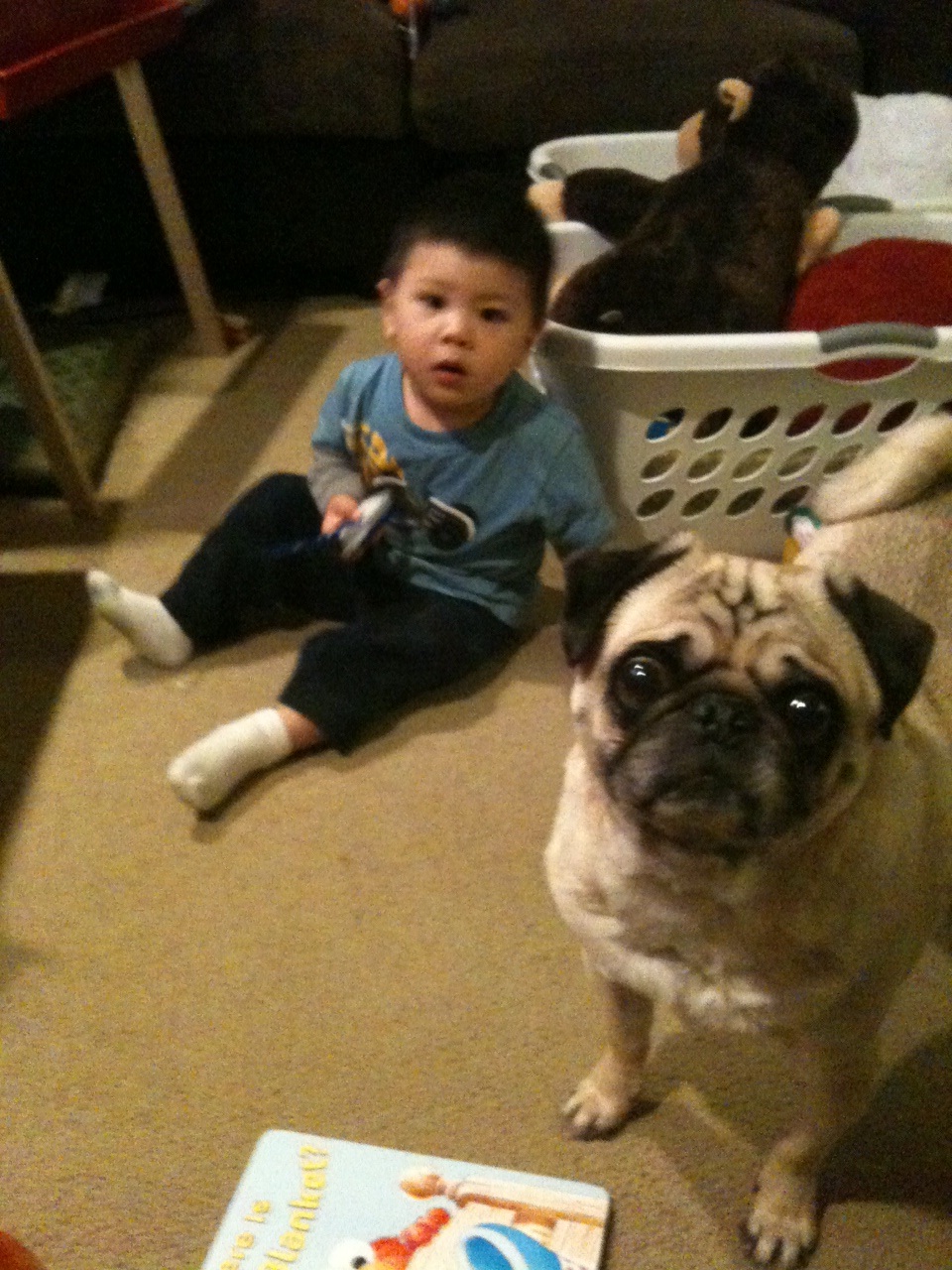
Memorial Day weekend is usually a time of relaxation, good food, and fun, family outings. But the Sugimura family was having a very different kind of holiday experience. Sammy, their beloved 7-year old Pug, had not eaten for two days. In addition to the lack of appetite he was vomiting bile.  Extremely worried, Sammy’s family took him to a veterinary clinic they had used in the past. After numerous tests they were unable to find anything conclusive. The Sugimuras took Sammy home fully hydrated, hoping he would get better. Instead, Sammy continued to get worse and began vomiting bile several times a day. After doing some research online, Sammy’s dad Jeff decided to call Bishop Ranch Veterinary Center & Urgent Care. “Renee took my call and her genuine concern for Sammy shone through on the phone.  He had started breathing heavily, like a canine version of Darth Vader, and he was getting cold . . .” said Jeff.  Renee had Jeff bring Sammy down immediately for Urgent Care.

Upon presentation Sammy was very weak and had difficulty getting up.  When Dr. Larry Gilman examined him he found Sammy to be very cold with a painful abdomen. Even his breath was cold! It was determined that Sammy was in shock and probably had an intestinal obstruction. Dr. Gilman and his team of technicians immediately sprang into action by using special medical equipment to help heat Sammy up as well as placing him on an IV in order to administer large doses of fluids to combat the shock. Dr. Gilman’s next step was to talk to the Sugimuras about developing a plan of action. Additional diagnostics needed to be performed including blood work in our in-house laboratory, digital x-rays, and possibly an ultrasound. While these tests were being performed Sammy was started on critical care support consisting of fluids, hetastarch, antibiotics, and pain medication in order to combat his severe state of shock and dehydration. Just as Dr. Gilman suspected, his x-rays showed an intestinal blockage in his small intestines which was confirmed with an ultrasound. To complicate matters, Sammy’s blood work revealed that he was in acute kidney failure due to his shock and the length and severity of his illness. 


Dr. Gilman knew that once Sammy’s shock was managed surgery would be necessary in order to remove the blockage and that some of his intestines would have to be removed. Because of Sammy’s critical condition, his chances of surviving surgery were about 50/50. Dr. Gilman delivered the sober news to the anxious Sugimuras. According to Jeff, “I was very impressed with Dr. Gilman, who told us that he would require surgery and that there was a good chance we could lose Sammy due to his already compromised condition.  You never want to hear news like this, but we appreciated his candor and how straight-forward he was.  You can't sugar coat things like this and many try and do this in the same situation.  For my wife and me, it wasn't a difficult decision aside from a costly one.  Sammy is our ‘first child’ and we weren't going to just give up on him.  So we authorized Dr. Gilman to perform the surgery and hoped for the best.”


The next few hours were spent treating Sammy’s shock, dehydration, pain, and kidney failure. As soon as his temperature was back up and his pain was under control it was time to go into surgery. Jeff and his wife came in to see Sammy prior to surgery. This was a very emotional time for them since they knew Sammy might not make it. Dr. Gilman had prepared them and let them know that even if he made it through the surgery, there was a still a risk that Sammy might succumb to his injuries during recovery.  Jeff shared, “We took our 4 1/2 year old son, CJ over to see Sammy before they put him under.  We wanted to say our goodbye's just in case it was the last time we saw him.  Unfortunately, our son didn't really ‘get it’ and was more interested in the other dogs at the hospital and why some of them had cones on their heads.”


The surgery was performed and a 24-inch section of Sammy’s intestine had to be removed since the foreign body had caused severe compromise of the intestinal tissue and its blood supply. Sammy was closely observed throughout the surgery using our specialized equipment for monitoring vital signs such as blood pressure, heart rate and rhythm, and respiratory rate. The foreign body that was causing the obstruction was removed and revealed to be a mass of human hair. It turns out that Sammy had a bad habit of licking the carpet and over time had accumulated a mass of hair in his intestines. This was difficult news for Jeff’s wife, as she had the long hair in the family. To make matters worse, she had to leave town the day after surgery on a business trip for two weeks. Needless to say it was devastating for her to have to leave Sammy’s side not knowing if he was going to survive or not.

Sammy’s surgery was a success but the next 48 hours were critical to his recovery. He needed to stay at Bishop Ranch Veterinary Center in order to receive post-operative critical care so we could monitor his kidneys and the healing of his intestines. 24-hour care from highly trained veterinary technicians was absolutely essential during this sensitive window of time.  Sammy was in Patient Care for three days. He was making a very good recovery – his vitals looked good, he was responsive to treatment, and was getting happier every day. The only problem was he wouldn’t eat. Dr. Gilman discussed the situation with Jeff and they agreed to see how Sammy would do at home on medication and a bland diet. Since all of his vitals looked positive and proper nutrition is important for the intestines to heal, home treatment was the next logical step in Sammy’s recovery. Their decision was the right one. Once he was back in the familiar comfort of his own home, Sammy began to regain his appetite. 

Dr. Gilman was in contact with Jeff daily for the next few days in order to make sure Sammy was still on the right track. When the tough little pug returned two weeks later for his suture removal he was completely back to normal and had made a full recovery! Sammy is back to his favorite activity of running around outside chasing the birds and squirrels, his appetite is as healthy as ever, and loves playing with his best human friends – the Sugimura’s two children CJ and Jace!
Jeff had the following to say after Sammy’s harrowing ordeal, “If you looked at him today, you'd never know he went through all that he did.  And that's exactly how I like it.  We're so fortunate to be able to have more time with him and that he was such a great fighter.  It also was another reminder about how you can't take each day with others for granted (or take others for granted) because you'll never know when you might face losing those that you love.  I have to say that everyone that I came into contact with was courteous, polite and you could tell that they really cared about the animals as though they were family (Sammy HAD become family after all he went through as most of the staff recognized him by the time we left!).  The professionalism and kindness exhibited throughout the clinic is stellar. . . Dr. Gilman was a breath of fresh air as a doctor.  He is a straight shooter, gets right to the point and doesn't sugar coat anything (which I really appreciate).  Throughout the process, Renee would sit down with me and go over the bill and specific charges so that we always knew where we stood.  Was it cheap? No.  But what kind of quality care is?  They were very straight-forward with the financial side of it and I very much appreciated it.  Dr. Gilman saved our Sammy's life and I am truly thankful for everything that he and the rest of the staff did for our dog.  Our kids are thrilled to have Sammy back at home safe (OK, our 2 year old has no idea what happened and what Sammy had been through, but they're still best friends). As far as I am concerned, Dr. Gilman is Sammy's new vet and the Bishop Ranch Veterinary Center has gained a new client in our family.”

The staff and doctors at Bishop Ranch Veterinary Center & Urgent Care work together as a team in order to provide the best possible care for your pet and for you! Life does not slow down for emergencies but we are here to help you and your pet when you need it the most.

Thursday, July 5, 2012

Communication Enhances Medical Care: Treating Finnian by Janice Cain, DVM, DACVIM


Finnian's face before.
When Nancy agreed to adopt Finnian, a handsome and affectionate cat, from a rescue group, she knew she had a battle ahead. Finnian had been tentatively diagnosed with pemphigus foliaceus, an uncommon skin disorder that causes the skin to literally peel off, leaving painful scabs and crusts behind. At the time of adoption, Finnian's skin disease was under control, but he was having serious side effects to his medication, including diabetes, and his skin was so thin that it would easily tear. After several frustrating weeks of trying to manage his condition, Finnian was in trouble. I had treated Nancy's other pets in the past, so she brought Finnian to the Bishop Ranch Veterinary Center, to see if I could assist her with this challenge. 


Finnian's face after!
We have won and lost a few of the battles with Finnian's complicated illness. Nancy has been very faithful to bring him in for numerous recheck examinations, but at times his condition would change almost daily. We constantly needed to modify his mediations and doses. We found that through intense email communication, that we have been able to form a partnership that has been extremely successful. After a severe relapse of the pemphigus, and an amazingly nasty ear infection, we finally have achieved a balance of medications that are working. Between Nancy's diligent nursing care and my counsel regarding the medical management of his numerous problems, I am happy to report that Finnian has dramatically improved. 

The art of communication is the key to any successful relationship. Today's technology strengthens the bond between veterinarian and client, allowing us to successfully manage even the most challenging of medical conditions together.   


Dr. Cain graduated from the Veterinary School at the University of California, Davis in 1984. Following a residency there she became board certified in Internal Medicine in 1989. Her special interests are Internal Medicine, Oncology, Endocrinology, and Canine Reproduction. She is a nationally recognized expert in Canine Reproduction, and has lectured at veterinary conferences around the country. She lives in Pleasanton with her husband, 3 children and their dog.

Monday, June 25, 2012

Lives Saved: Tucker Klopp by Megan Klopp


Age: 4 years
Breed: Newfoundland
Diagnosis: Heatstroke 


On September 15, 2010 Tucker and I set out for Starbucks -- a common and often visited destination of ours. It was a warm day, but not unusually hot -- he has walked in much hotter conditions many times before so I did not think the weather was a problem when I checked the temperature. 

Upon returning home, Tucker was drooling and panting as he always does, but he was walking abnormally and was non responsive when I talked to him. I feared heatstroke as I had just read about it the day before at our vet's office. We immediately hosed him down to cool him off as much as possible and lifted our unresponsive 140 lb dog (this was so difficult emotionally and physically) into the car and rushed him to our vet's office, Bishop Ranch Veterinary Center. When we got there, they were waiting for us in the parking lot with a stretcher! His temperature was at least 110 degrees – the thermometer only goes to 110 so it may have been higher! Dr. Michele Dodd and her team were very concerned and honest in telling us that they have never seen a dog survive this condition with this high of a temperature -- the situation was grave and his survival did not look promising -- but they would do everything they could to save him! 

Over the next two days he was in critical condition as his organs/system had shut down and he was bleeding internally – unable to clot. He was on numerous machines, getting IV's and Plasma units around the clock; it was serious and very frightening. 

The entire hospital staff could not have been more kind, sensitive, thorough, patient and concerned for Tucker. We received frequent phone calls with updates from the doctors and nurses and there was always someone available to talk to in the middle of the night when I would call unable to sleep. They let us visit him whenever we wanted and we would stay with him as long as we liked. Dr. Dodd was incredibly professional -- going the extra mile -- she even consulted with holistic doctors for other healing options. I know Tucker was not her only patient but she sure made us feel like he was! 

By the third day, we were so thankful to learn that Tucker was going to survive -- only time would tell if he would have any long-term health concerns. He remained at the hospital for another three days until his vitals were consistent and he was healthy enough to come home. 

We are truly so thankful and blessed that Tucker had the care he received as he would likely not be with us today if he had been elsewhere. Thanks to everyone at Bishop Ranch Veterinary Center, we still have our sweet beast! Tucker enjoys going to the hospital and seeing all his friends and fans! Each time he does he reminds them that because of their efforts and care, he is a "survivor"! 
Tucker is keepin' cool!


Wednesday, May 9, 2012

A Close Call: Tuffy and the Rattlesnake by Erin Selby

Poor swollen Tuffy!
Last Saturday, Tuffy was rushed to Bishop Ranch Veterinary Center & Urgent Care after being bit twice by a rattlesnake in the face! This happened in her own backyard – Tuffy and her family live on a ranch in Livermore. She was treated immediately with pain medication and stayed overnight for care. Her severe swelling had to be constantly monitored and measured to ensure she was improving. 

She's not feeling too well...

Rattlesnake bite symptoms are very serious; besides the extreme swelling and pain, the toxins from the venom disrupt blood clotting and interfere with circulation. This can lead to shock and death. The swelling can also impair a pet’s ability to breath – also leading to death. Necrosis of the wounded tissue can occur, sometimes leading to amputation. It is not surprising that rattlesnake bites are 20 to 25 times more fatal in dogs than in humans. 

Monitoring her progress.
Luckily, Tuffy’s treatment went well, she improved and was able to go home with her family on Sunday. Rattlesnake bites are a reality for pet owners in the East Bay. The rattlesnake vaccine can help your dog when they need it most by lessening the severity of the reaction and buying valuable time to get to the vet for treatment. Rattlesnake vaccines are only $25 though the month of May. You can learn more about the vaccine here. You can also read Dr. Weaver's blog about rattlesnakes, the vaccine, and rattlesnake avoidance tips here.


Friday, January 6, 2012

Lives Saved: Dexter by Erin Selby with Dr. Leanne Taylor, DVM


They may walk on four legs and have a fur coat but our pets aren’t that different from us - especially when it comes to their health. Just like us, things happen unexpectedly.  Whether it is an emergency situation or a serious health condition, our pets are not immune to the unanticipated, the unforeseen, and the unpredictable. And just like us, health insurance can play a huge part in whether the unexpected becomes an unbearable financial burden.

While any pet can become ill or require urgent care in case of an emergency, purebred animals are often born with inherent health problems. English Bulldogs are one of these breeds. Dexter is the reason people adopt English Bulldogs.  He is friendly, expressive, playful, and full of character. All of this is packed into the most compact little short-nosed body, in other words: ADORABLE.  He is also an example of why it is so important to invest in pet insurance. 
Dexter, in all his adorable glory!
Dexter was rushed to Bishop Ranch Veterinary Center & Urgent Care with uncommonly severe complications from a soft palate surgery performed at another practice. Poor Dexter was bleeding excessively into his airways and needed immediate care. BRVC brought in a specialist surgeon right away to control the bleeding and perform a tracheostomy in order to help him breathe. 

Bulldogs and other short nosed breeds such as Pugs, Pekinese, French Bulldogs and Boston Terriers, are brachycephalic breeds. These pets are born with anatomical problems due to their short faces and stocky bodies. The most common of these problems is a long soft palate, (the fleshy part of the roof of the mouth) that will cover the airway and contribute to problems breathing.  Brachycephalic dogs often require soft palate surgery in order to help resolve breathing issues. Most of the time these procedures go smoothly, but sometimes complications arise, as in Dexter’s case.   
Dexter and all English Bulldogs are brachycephalic
In addition to the complications that arose from his original procedure, Dexter developed pneumonia (another condition Bulldogs are prone to). Altogether, Dexter required nearly two weeks of hospitalization and follow-up care and underwent three major surgeries in the span of eight days. Everyone at Bishop Ranch Veterinary Center became very attached to the little fighter. The specialists, doctors, and technicians attending to Dexter did all they could to help keep the little guy going. His very dedicated owner became a common sight in the hospital halls and spent hours by the side of his beloved pet. It was touch and go for awhile but Dexter eventually pulled through and made a full recovery. He now breathes better than ever and is back to his adorable, playful ways.

Three surgeries. Weeks of hospitalization. Medications and hourly treatments. Follow up care. All of these things add up, and they add up fast. Dexter’s owners loved him deeply and wanted to do everything that could possibly be done to save his life. Fortunately they had signed Dexter up with Pet Plan Insurance when he was younger. Pet Plan is one of the few pet insurance companies that cover hereditary and congenital conditions, which makes it a great choice for purebred pets. While they worried about his health and whether he would make it through the night, they never had to worry about whether or not they could afford treatment. In the end, Pet Plan paid almost 90% of Dexter’s medical care. Talk about peace of mind (and wallet)!
Dexter wants you to pet him...
Dexter is now a regular at Bishop Ranch Veterinary Center where he comes in for the decidedly non-emergency kind of visit to have his toe nails trimmed, along with lots of TLC. He has everyone there wrapped around his chubby little paw. The unexpected and unforeseen happened to Dexter. He needed help and he needed it fast. Luckily, he had an excellent insurance plan that allowed his family the financial freedom to spare no expense when it came to Dexter’s health.