Showing posts with label emergency. Show all posts

Monday, April 29, 2013

Ask the Vet: Pet First Aid by Kristel Weaver, DVM, MPVM


I hope you will never need to administer first aid to your pets, but if an emergency should occur, it’s important to be mentally prepared.  These first aid tips are intended to get you and your pet safely to a veterinarian for medical care.

When a dog or cat is in pain, they may fight or try to bite.  I have seen the sweetest animals become aggressive and bite the people they love when they are scared and injured.  So it is very important to be cautious, especially around the mouth, with a dog or cat that is hurt.  You can create a muzzle with a necktie, stockings, or rolled gauze.  Never muzzle an animal that is vomiting.  You can create a kitty burrito by wrapping a cat up tightly in a blanket or towel.

How do I deal with the following emergencies?

Bleeding – If your pet has a wound that is bleeding excessively, apply direct pressure.  Don’t worry about cleaning it or treating it with antibiotic ointment, the first step is to stop the bleeding.  Apply a clean thick gauze pad to the wound and either hold the pad in place with manual pressure or use a bandage to secure it in place.  It may take 3 to 5 minutes or longer to get the bleeding to stop, so once the pressure has been applied, leave it there and don’t peek.

Broken bones – If you think your pet has a broken bone the goal is to get your pet to the veterinarian with as little movement as possible.  A poorly placed splint can cause more harm than good, so if the fracture is not bleeding externally, it is best not to touch the broken area.  For cats and small dogs use a small padded carrier for transport.  For large dogs use a heavy blanket or bedspread as a sling, put the dog in the center of the blanket and with two people pick up the corners to lift the dog into the car and to the veterinarian. 

If you think your pet has neck or spinal trauma, place them on their side on a firm surface (for small animals try a cookie sheet or box lid) and secure them so they cannot move.  Use a calm voice to be reassuring as you drive to the closest veterinary hospital.
 

Choking – If your pet is still breathing and he is not choking, try and let him get the object out himself.  Signs of choking are that your dog or cat is unable to breathe, is pawing at his mouth, or is turning blue. When an animal is choking and conscious they are more likely to bite.  Look in the mouth; if you see something pull it out with pliers or tweezers (not your fingers).  If your pet collapses because they cannot breathe, aim their head towards the floor by picking up their back legs and sway them back and forth to let gravity pull the object out.  If that doesn’t work thump their back with the palm of your hand several times, still aiming their head towards the ground.  If this doesn’t work, try a Heimlich maneuver by holding your pet with his back to your chest, make a fist in the soft spot below the ribs and push in and up with both hands.  Be very gentle doing this on small dogs and cats.

Heatstroke – If you think your dog is suffering from heatstroke, hose him off with cool water, especially in the groin and armpits. Do not submerge them in ice cold water as this can make the situation worse. Offer cool water to drink.  Cover him with wet towels, changing them out for cool ones every few minutes as you drive to the veterinarian with the air conditioning on.

Seizure – If your dog or cat has a seizure you won’t be able to make it stop, so don’t try.  You simply need to wait it out and make sure they don’t get hurt.  Move them away from sharp objects and prevent them from falling off furniture.  If possible, turn their head towards the ground so they do not inhale vomit or saliva.  Finally, use a stopwatch to time how long the seizure lasts.  It will feel like an eternity, but chances are it lasts less than a minute.

Not breathing – If your pet is not breathing and unconscious, open their mouth, pull their tongue out and check for something stuck in their throat.  If their airway is clear, hold their mouth closed and breathe into their nose until you see the ribcage gently rise.  Continue to administer breaths every 4 to 5 seconds while someone drives you and your pet to the closest veterinarian.

Toxins – If you pet gets a toxin on his coat or hair, wash him off using warm water and dish soap.  If a toxin gets in the eyes, flush them with sterile saline.  If your pet ingests something that may be toxic call animal poison control (888) 426-4435 as you head to the veterinarian.  The veterinarian will need to know what it is that your pet ate and how much, so bring the packaging with you.

Hopefully these tips help you to be prepared for an emergency.  In many communities you can take a pet first aid class to practice some of these skills.  Remember to stay calm and to use a soothing voice to reassure your pet in an emergency.

Dr. Kristel Weaver is a graduate of the Veterinary School at the University of California, Davis where she received both a DVM and a Master’s of Preventative Veterinary Medicine (MPVM).  She has been at Bishop Ranch Veterinary Center & Urgent Care in San Ramon since 2007.  She currently lives in Oakland with her husband and their daughter, Hayley. If you have questions you would like Dr. Weaver to answer for future articles, please email info@webvets.com

Friday, March 8, 2013

Snail Bait Poisoning


Snail bait is the most common poisoning agent of dogs in California. Warning signs of snail bait poisoning include anxious twitching that becomes uncontrollable, racing heart rate, vomiting, diarrhea and respiratory failure.The twitching progresses to seizures and potentially death. Seizures can raise a pet's body temperature so high that brain damage can occur.

Know the facts:
  • The toxic ingredient in snail bait is metaldehyde and can cause seizures in animals that can be fatal.
  • Snail bait is commonly sold in pellets that resemble dog food and have a flavor that attracts dogs.
  • Snail bait can be licked off paws during grooming.
  • It takes less than one teaspoon per 10lbs of body weight for snail bait to become toxic.
Pet-safe alternatives to snail bait include Sluggo Slug & Snail Bait, handpicking, and copper barriers. You can read more about snail bait from Dr. Utchen by clicking here.  

If you think your pet may have ingested snail bait call us immediately at 925.866.8387! 
 

Monday, October 1, 2012

Ask the Vet: Disaster Preparedness by Kristel Weaver, DVM, MPVM


What would you do with your pets in the event of a disaster?  This month’s article discusses preparing for an emergency.  If you don’t have a plan for yourself and your family, this is a good time to take care of that too!

How can I prepare to take care of my pets in an emergency?

  • Gather supplies into a portable kit.  Include items that your pets need on a daily basis or would need if they had to evacuate your house and live somewhere else.  In addition to food and water for a week, add a bowl, can opener, leash, carrier, health record/vaccine history and any medications that your pet may be taking.  If you have a cat include some disposable cat litter trays and cat litter, as well as trash bags for clean up.  Be sure to change out dry pet food every 2 months.  Canned food lasts much longer (but check expiration dates).

  • Have a plan and test it out.  Think about how you would evacuate your house and where you would go.  Research where you can stay with your pet as not all evacuation shelters accept pets.  Make a list of the contact information for friends, family, or pet-sitters that might take care of your pets.  Also research local boarding kennels.  Have a practice evacuation drill with your family and pets.

  • Keep identification information current.  Make sure your phone number is correct on each pet’s tag and that the contact information on their microchips is up to date.  Have your pet microchipped if he or she is not already.

  • Prepare a pet first aid kit.  Include bandage material, an antibiotic cream, Benadryl (ask your vet for the appropriate dose for your pet), scissors and tweezers. You can see a list of item for starting your own pet first aid kit here.

  • Place a pet alert decal near your front door.  You can get one of these for free from the ASPCA or buy them from vendors online.

  • Carry current photos of your pets with you, in case you need to make a lost pet poster.

  • Know where to search for lost animals.  If your pet is lost and running on the streets they could end up in the local animal shelter, humane society, or SPCA.  This is also why current ID tags and a microchip are so important. Have a list of local animal shelters and their phone numbers with your emergency kit.

Having a plan and being prepared is your best defense in case of an emergency or natural disaster. Hopefully, you will never have to implement your plan but knowing you are prepared will give you peace of mind. I hope this article inspires you to plan and prepare for your family - including the four-legged members!

Dr. Kristel Weaver is a graduate of the Veterinary School at the University of California, Davis where she received both a DVM and a Master’s of Preventative Veterinary Medicine (MPVM).  She has been at Bishop Ranch Veterinary Center & Urgent Care in San Ramon since 2007.  She currently lives in Oakland with her husband and their daughter, Hayley. If you have questions you would like Dr. Weaver to answer for future articles, please email info@webvets.com


Monday, July 30, 2012

Lives Saved: Sammy by Erin Selby

Name: Sammy Sugimura 
Age: 7 1/2 years 
Breed: Pug
Diagnosis: Intestinal Obstruction

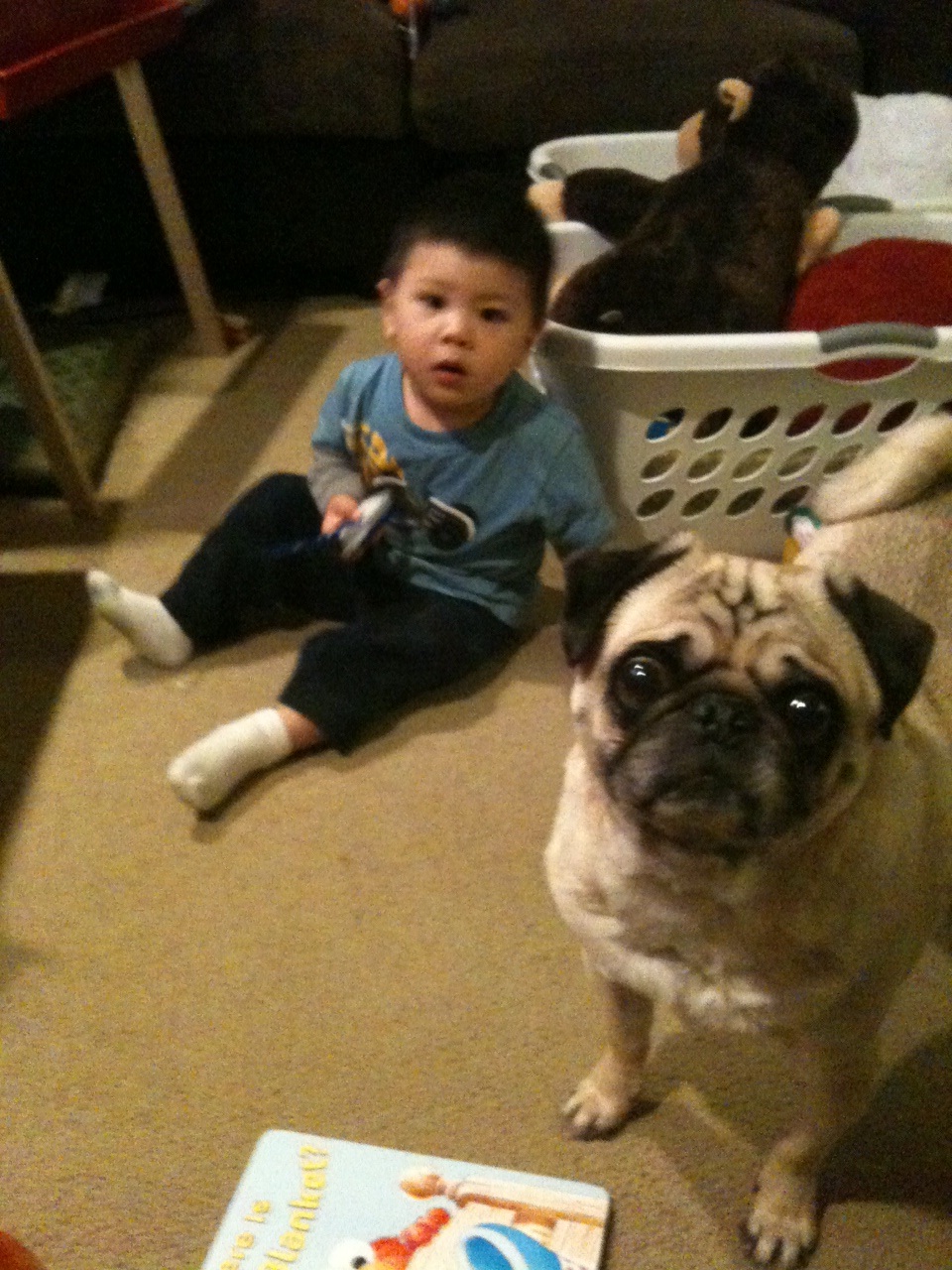
Memorial Day weekend is usually a time of relaxation, good food, and fun, family outings. But the Sugimura family was having a very different kind of holiday experience. Sammy, their beloved 7-year old Pug, had not eaten for two days. In addition to the lack of appetite he was vomiting bile.  Extremely worried, Sammy’s family took him to a veterinary clinic they had used in the past. After numerous tests they were unable to find anything conclusive. The Sugimuras took Sammy home fully hydrated, hoping he would get better. Instead, Sammy continued to get worse and began vomiting bile several times a day. After doing some research online, Sammy’s dad Jeff decided to call Bishop Ranch Veterinary Center & Urgent Care. “Renee took my call and her genuine concern for Sammy shone through on the phone.  He had started breathing heavily, like a canine version of Darth Vader, and he was getting cold . . .” said Jeff.  Renee had Jeff bring Sammy down immediately for Urgent Care.

Upon presentation Sammy was very weak and had difficulty getting up.  When Dr. Larry Gilman examined him he found Sammy to be very cold with a painful abdomen. Even his breath was cold! It was determined that Sammy was in shock and probably had an intestinal obstruction. Dr. Gilman and his team of technicians immediately sprang into action by using special medical equipment to help heat Sammy up as well as placing him on an IV in order to administer large doses of fluids to combat the shock. Dr. Gilman’s next step was to talk to the Sugimuras about developing a plan of action. Additional diagnostics needed to be performed including blood work in our in-house laboratory, digital x-rays, and possibly an ultrasound. While these tests were being performed Sammy was started on critical care support consisting of fluids, hetastarch, antibiotics, and pain medication in order to combat his severe state of shock and dehydration. Just as Dr. Gilman suspected, his x-rays showed an intestinal blockage in his small intestines which was confirmed with an ultrasound. To complicate matters, Sammy’s blood work revealed that he was in acute kidney failure due to his shock and the length and severity of his illness. 


Dr. Gilman knew that once Sammy’s shock was managed surgery would be necessary in order to remove the blockage and that some of his intestines would have to be removed. Because of Sammy’s critical condition, his chances of surviving surgery were about 50/50. Dr. Gilman delivered the sober news to the anxious Sugimuras. According to Jeff, “I was very impressed with Dr. Gilman, who told us that he would require surgery and that there was a good chance we could lose Sammy due to his already compromised condition.  You never want to hear news like this, but we appreciated his candor and how straight-forward he was.  You can't sugar coat things like this and many try and do this in the same situation.  For my wife and me, it wasn't a difficult decision aside from a costly one.  Sammy is our ‘first child’ and we weren't going to just give up on him.  So we authorized Dr. Gilman to perform the surgery and hoped for the best.”


The next few hours were spent treating Sammy’s shock, dehydration, pain, and kidney failure. As soon as his temperature was back up and his pain was under control it was time to go into surgery. Jeff and his wife came in to see Sammy prior to surgery. This was a very emotional time for them since they knew Sammy might not make it. Dr. Gilman had prepared them and let them know that even if he made it through the surgery, there was a still a risk that Sammy might succumb to his injuries during recovery.  Jeff shared, “We took our 4 1/2 year old son, CJ over to see Sammy before they put him under.  We wanted to say our goodbye's just in case it was the last time we saw him.  Unfortunately, our son didn't really ‘get it’ and was more interested in the other dogs at the hospital and why some of them had cones on their heads.”


The surgery was performed and a 24-inch section of Sammy’s intestine had to be removed since the foreign body had caused severe compromise of the intestinal tissue and its blood supply. Sammy was closely observed throughout the surgery using our specialized equipment for monitoring vital signs such as blood pressure, heart rate and rhythm, and respiratory rate. The foreign body that was causing the obstruction was removed and revealed to be a mass of human hair. It turns out that Sammy had a bad habit of licking the carpet and over time had accumulated a mass of hair in his intestines. This was difficult news for Jeff’s wife, as she had the long hair in the family. To make matters worse, she had to leave town the day after surgery on a business trip for two weeks. Needless to say it was devastating for her to have to leave Sammy’s side not knowing if he was going to survive or not.

Sammy’s surgery was a success but the next 48 hours were critical to his recovery. He needed to stay at Bishop Ranch Veterinary Center in order to receive post-operative critical care so we could monitor his kidneys and the healing of his intestines. 24-hour care from highly trained veterinary technicians was absolutely essential during this sensitive window of time.  Sammy was in Patient Care for three days. He was making a very good recovery – his vitals looked good, he was responsive to treatment, and was getting happier every day. The only problem was he wouldn’t eat. Dr. Gilman discussed the situation with Jeff and they agreed to see how Sammy would do at home on medication and a bland diet. Since all of his vitals looked positive and proper nutrition is important for the intestines to heal, home treatment was the next logical step in Sammy’s recovery. Their decision was the right one. Once he was back in the familiar comfort of his own home, Sammy began to regain his appetite. 

Dr. Gilman was in contact with Jeff daily for the next few days in order to make sure Sammy was still on the right track. When the tough little pug returned two weeks later for his suture removal he was completely back to normal and had made a full recovery! Sammy is back to his favorite activity of running around outside chasing the birds and squirrels, his appetite is as healthy as ever, and loves playing with his best human friends – the Sugimura’s two children CJ and Jace!
Jeff had the following to say after Sammy’s harrowing ordeal, “If you looked at him today, you'd never know he went through all that he did.  And that's exactly how I like it.  We're so fortunate to be able to have more time with him and that he was such a great fighter.  It also was another reminder about how you can't take each day with others for granted (or take others for granted) because you'll never know when you might face losing those that you love.  I have to say that everyone that I came into contact with was courteous, polite and you could tell that they really cared about the animals as though they were family (Sammy HAD become family after all he went through as most of the staff recognized him by the time we left!).  The professionalism and kindness exhibited throughout the clinic is stellar. . . Dr. Gilman was a breath of fresh air as a doctor.  He is a straight shooter, gets right to the point and doesn't sugar coat anything (which I really appreciate).  Throughout the process, Renee would sit down with me and go over the bill and specific charges so that we always knew where we stood.  Was it cheap? No.  But what kind of quality care is?  They were very straight-forward with the financial side of it and I very much appreciated it.  Dr. Gilman saved our Sammy's life and I am truly thankful for everything that he and the rest of the staff did for our dog.  Our kids are thrilled to have Sammy back at home safe (OK, our 2 year old has no idea what happened and what Sammy had been through, but they're still best friends). As far as I am concerned, Dr. Gilman is Sammy's new vet and the Bishop Ranch Veterinary Center has gained a new client in our family.”

The staff and doctors at Bishop Ranch Veterinary Center & Urgent Care work together as a team in order to provide the best possible care for your pet and for you! Life does not slow down for emergencies but we are here to help you and your pet when you need it the most.

Monday, June 25, 2012

Lives Saved: Tucker Klopp by Megan Klopp


Age: 4 years
Breed: Newfoundland
Diagnosis: Heatstroke 


On September 15, 2010 Tucker and I set out for Starbucks -- a common and often visited destination of ours. It was a warm day, but not unusually hot -- he has walked in much hotter conditions many times before so I did not think the weather was a problem when I checked the temperature. 

Upon returning home, Tucker was drooling and panting as he always does, but he was walking abnormally and was non responsive when I talked to him. I feared heatstroke as I had just read about it the day before at our vet's office. We immediately hosed him down to cool him off as much as possible and lifted our unresponsive 140 lb dog (this was so difficult emotionally and physically) into the car and rushed him to our vet's office, Bishop Ranch Veterinary Center. When we got there, they were waiting for us in the parking lot with a stretcher! His temperature was at least 110 degrees – the thermometer only goes to 110 so it may have been higher! Dr. Michele Dodd and her team were very concerned and honest in telling us that they have never seen a dog survive this condition with this high of a temperature -- the situation was grave and his survival did not look promising -- but they would do everything they could to save him! 

Over the next two days he was in critical condition as his organs/system had shut down and he was bleeding internally – unable to clot. He was on numerous machines, getting IV's and Plasma units around the clock; it was serious and very frightening. 

The entire hospital staff could not have been more kind, sensitive, thorough, patient and concerned for Tucker. We received frequent phone calls with updates from the doctors and nurses and there was always someone available to talk to in the middle of the night when I would call unable to sleep. They let us visit him whenever we wanted and we would stay with him as long as we liked. Dr. Dodd was incredibly professional -- going the extra mile -- she even consulted with holistic doctors for other healing options. I know Tucker was not her only patient but she sure made us feel like he was! 

By the third day, we were so thankful to learn that Tucker was going to survive -- only time would tell if he would have any long-term health concerns. He remained at the hospital for another three days until his vitals were consistent and he was healthy enough to come home. 

We are truly so thankful and blessed that Tucker had the care he received as he would likely not be with us today if he had been elsewhere. Thanks to everyone at Bishop Ranch Veterinary Center, we still have our sweet beast! Tucker enjoys going to the hospital and seeing all his friends and fans! Each time he does he reminds them that because of their efforts and care, he is a "survivor"! 
Tucker is keepin' cool!


Monday, June 4, 2012

Ask the Vet - Gastric Dilation and Volvulus (GDV) AKA Canine Bloat by Kristel Weaver, DVM, MPVM


I just adopted a Great Dane puppy and my breeder mentioned some precautions to prevent bloat.  What is bloat?

Bloat, or gastric dilatation and volvulus (GDV), is when the stomach fills with gas and flips over. This twists blood vessels, blocks blood flow and traps gas. The gas and pressure builds up, forcing the stomach to expand. Within a few hours or less the stomach is extremely stretched and hard, and the stomach tissue begins to die. Circulation is cut off, causing the dog to go into shock. Without emergency treatment GDV is fatal. Even with aggressive therapy, some dogs do not survive.

 What does a dog with GDV look like?

Dogs with GDV are very uncomfortable – as you can just imagine! They act restless and try to vomit but nothing comes up. As their stomachs fill with gas, their abdomen appears bloated just behind the ribs. If you think your dog has these symptoms, regardless of the breed, take him or her to your veterinarian immediately.

What causes GDV and what breeds are at risk?

No one knows exactly what cause GDV. Past cases show the biggest risk factor is a big, deep chest. The risk increases as a dog gets older and the ligaments around the stomach stretch out. The breed most at risk is the Great Dane; about 2 out of every 5 have GDV. Some other breeds at risk are St. Bernards, Setters, Weimaraners, Standard Poodles, German Shepherds, and the list goes on.

What can be done to prevent GDV?

A surgery called a gastropexy can prevent GDV. In it, the stomach is sewn to inside of the body wall, preventing it from flipping over. This surgery can be done safely with either a laparoscope or traditional surgical method. It's typically done at the same time a deep-chested or large breed dog is spayed or neutered. Aside from a gastropexy, there is no guaranteed method to prevent GDV. Another factor to consider is that emergency GDV treatment and surgery can range from $3000 to $7000, depending on the hospital, while a preventive laparoscopic gastropexy is about a third of that cost.
If you're concerned about bloat, talk to your veterinarian about a gastropexy. In my opinion, it is absolutely worth the peace of mind!  

Dr. Kristel Weaver is a graduate of the Veterinary School at the University of California, Davis where she received both a DVM and a Master’s of Preventative Veterinary Medicine (MPVM).  She has been at Bishop Ranch Veterinary Center & Urgent Care in San Ramon since 2007.  She currently lives in Oakland with her husband and their daughter, Hayley. If you have questions you would like Dr. Weaver to answer for future articles, please email info@webvets.com